
“I write to find out what I’m thinking.”
Intent
|
Our intent for writing education is to enable children to feel inspired, confident and ready to write for specific purposes and authentic audiences, and to choose to write in their own lives by developing: • Transcription • Language • Composition |

Implementation
Writing
Our writing curriculum develops pupils’ knowledge, motivation and confidence of the three big ideas through:
- A daily English lesson, as well as opportunities for sustained cross-curricular writing in other subject areas.
- Using the best practice model of the Essential Writing schemes of work.
- Providing pupils with opportunities and tools to write for a range of specific purposes and authentic audiences.
- Following a two year rolling programme to ensure children access complete coverage of the curriculum without unnecessary repetition.
- Adaptations to support with delivering a well-pitched curriculum within a mixed age class.
- Using diverse and high-quality literature as good examples of writing craft and to help to motivate or inspire children to write.
- Full alignment with the National Curriculum for English including writing composition, vocabulary, grammar & punctuation for each year group.
- Progressively structured writing units of work centred around the different writing purposes: to entertain; to inform; to persuade; to discuss.
- Progressively sequenced writing purposes across the school (see table below).
- Key Stage appropriate opportunities to generate ideas, plan, draft, proof-read, edit and share/publish high-quality oral and written compositions (see diagram below).
- Specific teaching of vocabulary, spelling, grammar and punctuation to support compositions.
- An English working wall to support learning, which is relevant to the current unit of work and includes the genre, audience and purpose.
- Author’s Journals for every pupil to supporting writing for pleasure.
- Magpie books in KS2 to collect ideas and support writing.
- A ‘Wow Writing’ display that celebrates writing achievements across all year groups.
- Spelling and writing achievements celebrated through certificates in our weekly Celebration Assembly.
- Specific and timely Little Wandle interventions for identified pupils.
- Logins for every pupil to Spelling Shed, to support with learning both in school and at home.
Children in Reception are not introduced to specific genres; instead, they take part in bookmaking projects to support their understanding that writing is a multi-sensory and joyous activity, that is purposeful. Within Year 1 – Year 6, genres linked to the writing purpose are studied across each year group as follows:

Spelling
- At Sproughton, we use the Little Wandle phonics scheme at EYFS and KS1.
- Children then progress onto the ‘Spelling Shed’ scheme which underpins the teaching and learning of spelling
- Spelling is taught daily in a spelling session and applied across all subjects
- Regular opportunities to learn and practise spelling is included in the Home Learning Policy
- Children are taught about the relationship between sounds and letters (phonics), word structure (morphology and etymology) and spelling structure (orthography)
- Children are taught to use a dictionary to find spellings and meanings of words; dictionaries are always available to support children’s learning
Handwriting
- At Sproughton Primary, children learn letter formation in the EYFS and year 1 underpinned by the Little Wandle phonics scheme
- In year 2 to 6, children are taught cursive writing using the Letterjoin scheme
- From year 3 onwards, children are encouraged to write with a fluently joined handwriting style.
- High expectations of handwriting are maintained across the curriculum
Impact
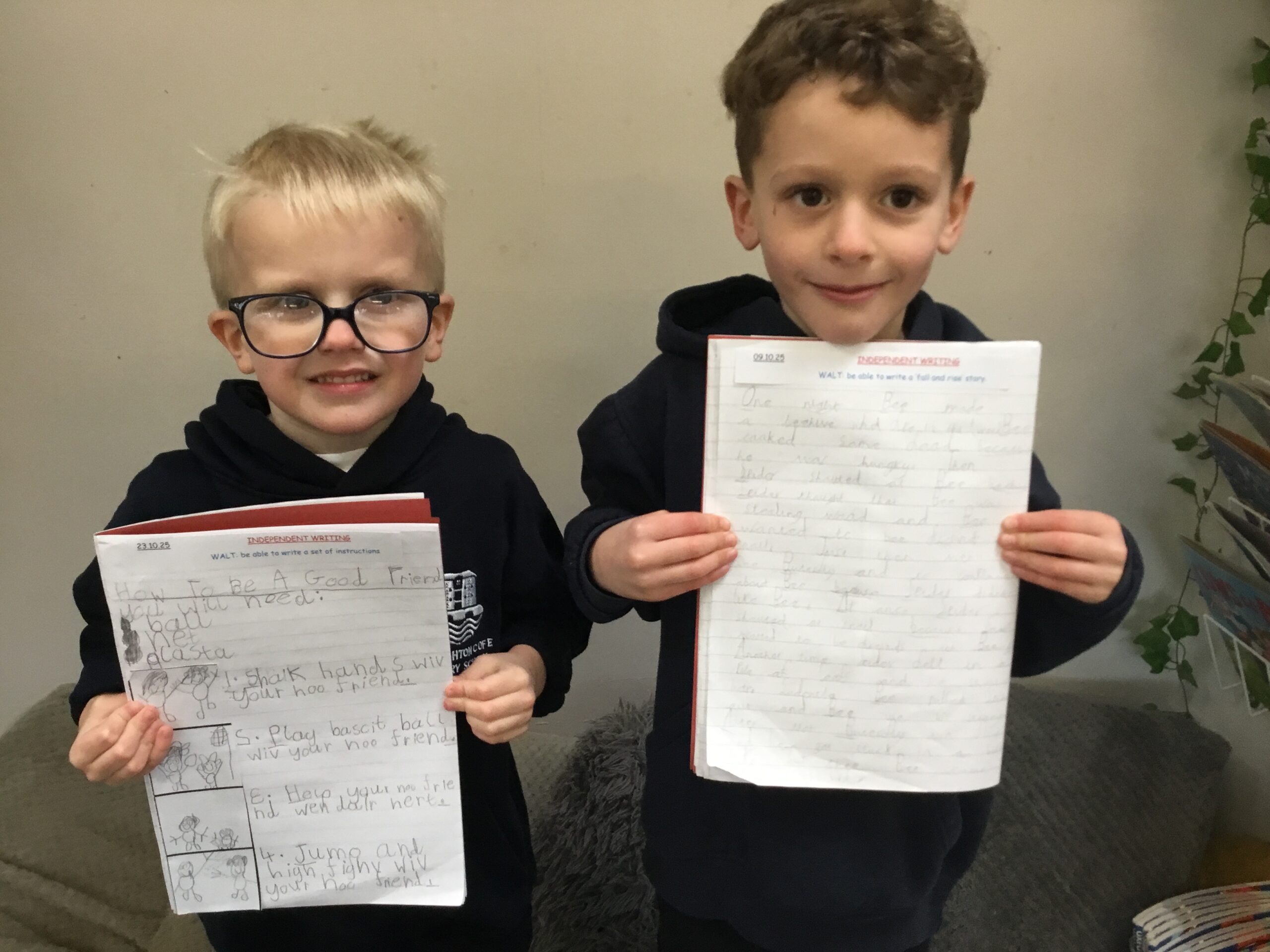


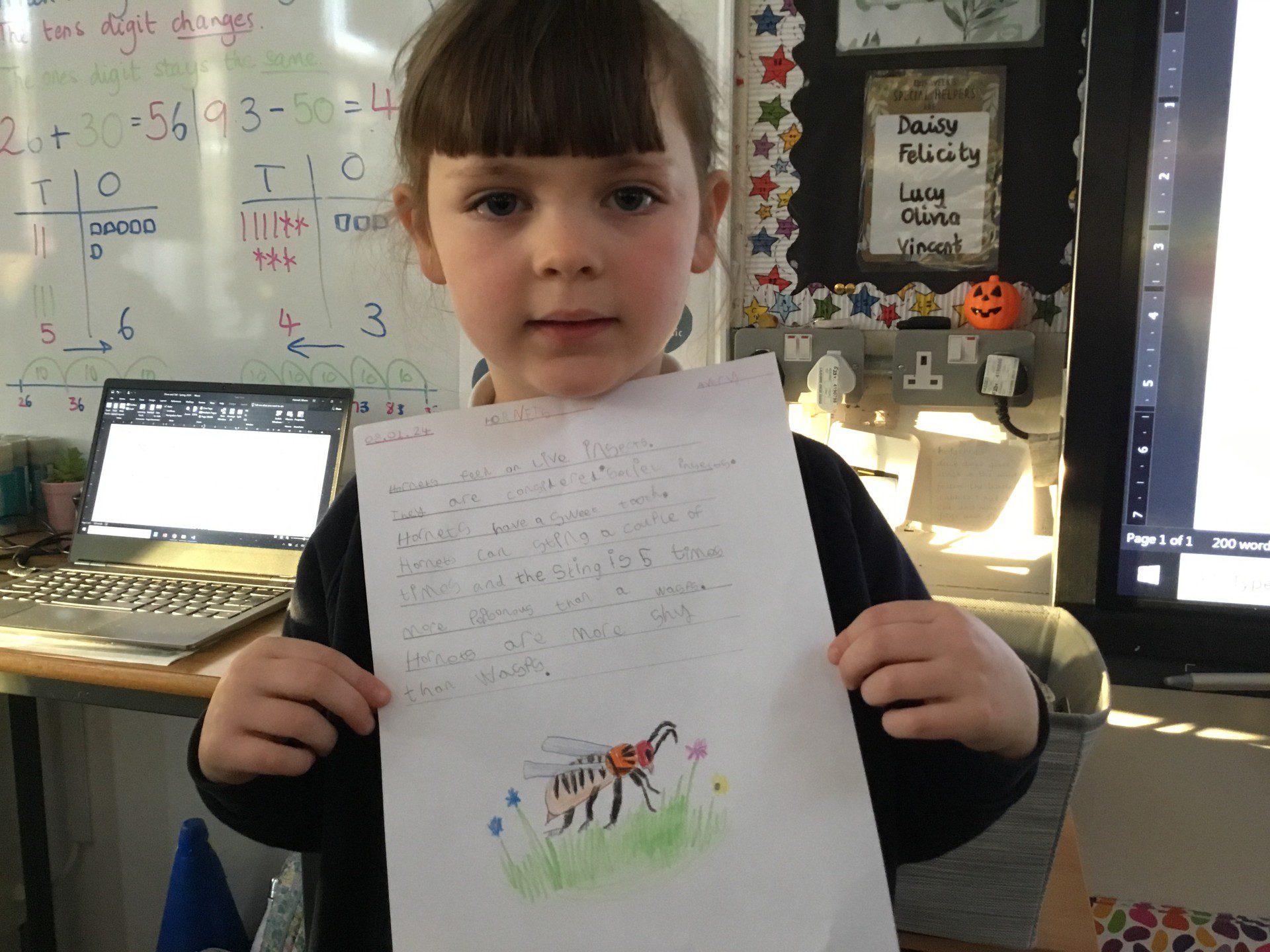


|
Children leave Sproughton C of E Primary School, securely at age expectation. This is evidenced through the three writing big ideas: 1. Transcription – I am a writer because I know and can use phonics and/or spelling rules/patterns, as well as accurate letter formation and joins to write fluently and legibly. 2. Language – I am a writer because I know and can use a range of vocabulary, grammatical structures and punctuation accurately and effectively. 3. Composition – I am a writer because I use my transcription and language skills to articulate and structure my ideas to create oral and/or written outcomes. |
Sproughton's Finalist BBC 500 Words Competition 2023! 50 finalists out of 44,000+ entries visited Buckingham Palace. Click the image below to listen to Ben's story read aloud by celebrity Ian Dunnett Jnr.

Learning and teaching in Writing is monitored regularly
by the subject leader for learning: Mrs Hannah Sibson
Also in this section
Sproughton C of E Primary School | Church Lane | Ipswich | IP8 3BB | 01473 742182 | admin@sproughton.suffolk.sch.uk
Please note that our office is staffed staffed between 8.30 am and 4pm during term time only.